 EN
EN
 ES
ES
 DE
DE
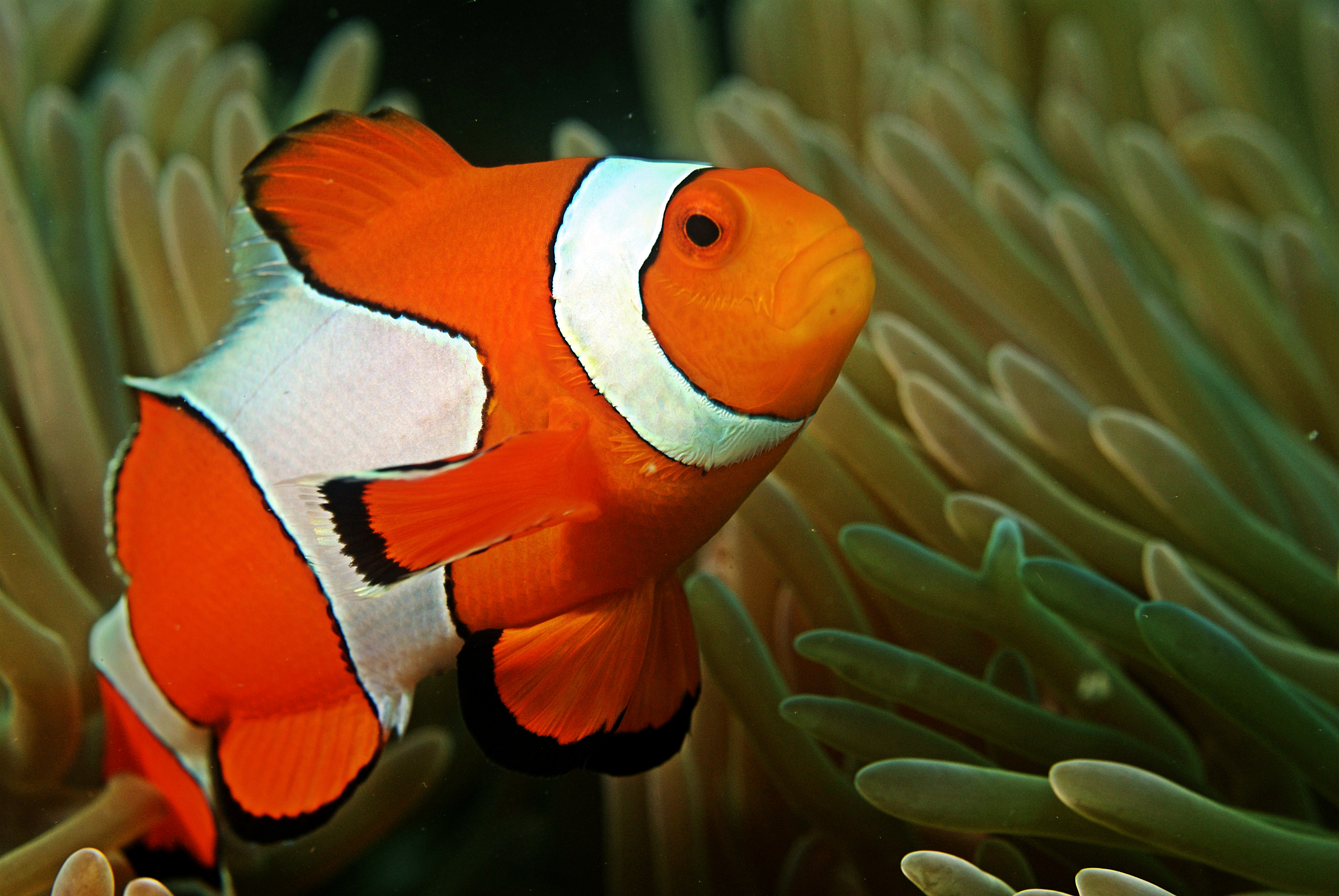
Common Clownfish
Amphiprion ocellaris
Lagoons and outer reef slopes of the western Pacific, always in symbiosis with host anemones.
Bright orange body with three vertical white bars edged in black. Similar to Amphiprion percula but with a thinner black edge.
Identification
The common clownfish — made globally famous by Finding Nemo — is the classic orange-and-white anemonefish of the Indo-Pacific. It is distinguished from the closely related Amphiprion percula by a thinner black edge on its white bars and finer black margins on the fins. Adults reach about 11 cm.
Distribution & Habitat
Native to the eastern Indian Ocean and western Pacific, from the Andaman Sea through Indonesia, the Philippines, and to northwestern Australia. Absent from Hawaii, the Red Sea, and the Atlantic — any "clownfish" seen in those regions is either a different species or an aquarium escapee.
Behavior
Clownfish live in obligate symbiosis with sea anemones, most often Heteractis magnifica, Stichodactyla gigantea, or S. mertensii. They are immune to the anemone's stinging nematocysts thanks to a specialized mucus coating, and they gain protection from predators in exchange for defending the anemone from butterflyfish that would otherwise nip its tentacles. Within each anemone lives a strict hierarchy: one dominant breeding female, a smaller breeding male, and non-breeding juveniles. If the female dies, the dominant male changes sex and takes her place. All clownfish are born male.
Where to See Them
Any tropical Indo-Pacific reef with healthy anemones. Raja Ampat, Komodo, and the Philippines are particularly productive. Do not handle the anemone; the clownfish's protective mucus is partly derived from its host, and interference can break the symbiosis.
Eastern Indian Ocean and western Pacific: Andaman Sea, Indonesia, Philippines, northwestern Australia.
Lives in groups within a single anemone. Social hierarchy led by a breeding female; if she dies, the dominant male changes sex to replace her.
Find diving tours where you might encounter this species:
Diving Tours & Activities
Book diving experiences with local operators