 EN
EN
 ES
ES
 DE
DE
Blue-ringed Octopus
Hapalochlaena maculosa
Shallow rocky reefs, tide pools, and sandy bottoms from the intertidal to 50 meters.
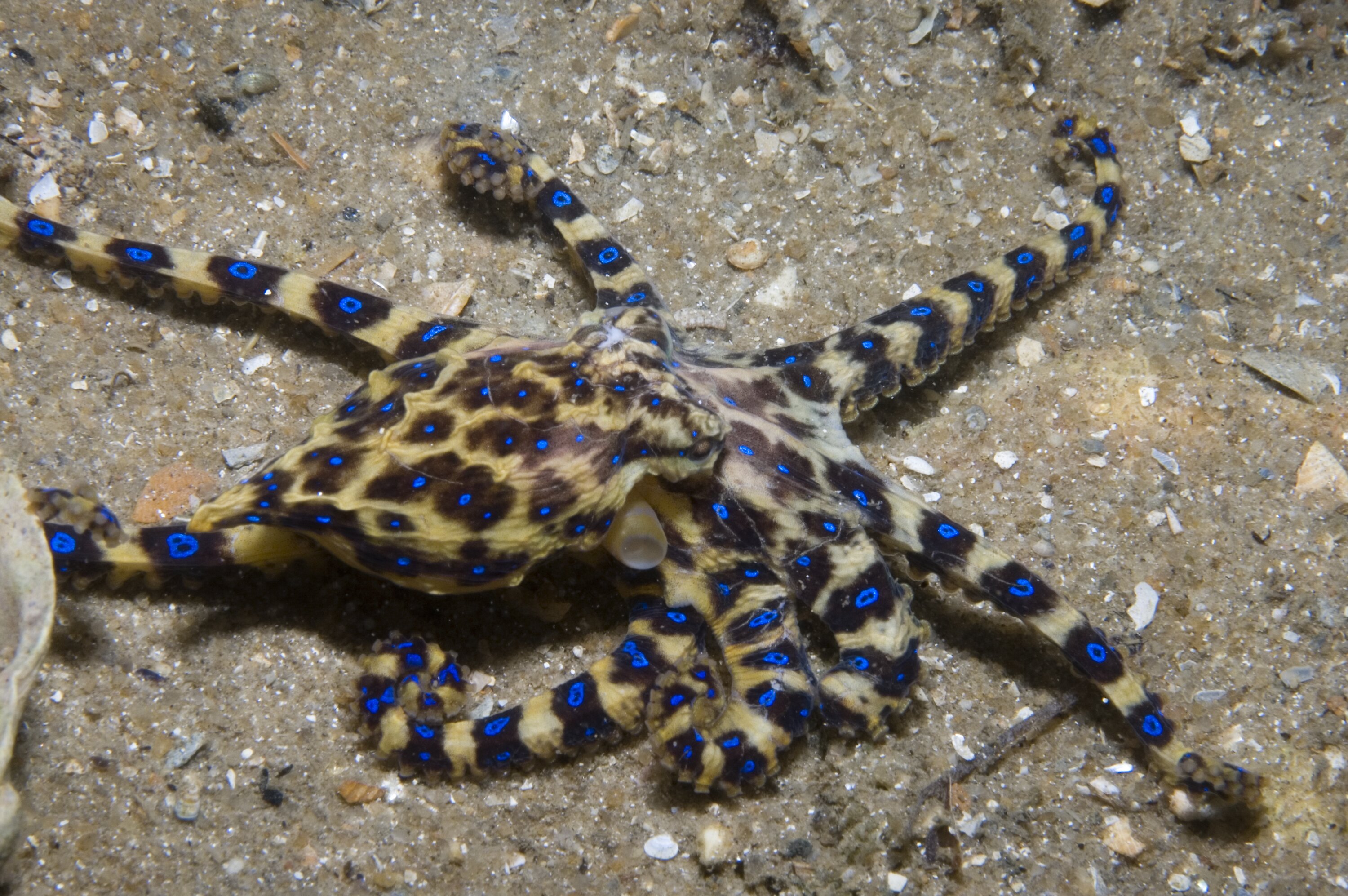
Tiny (under 20 cm), pale yellow-beige body. When threatened, displays brilliant iridescent blue rings that pulsate as a warning.
Identification
The blue-ringed octopus is small — rarely more than 20 cm including arms — and at rest is surprisingly bland: pale yellow-beige with faint brown banding. Its identifying feature only appears when the animal is threatened: dozens of vivid iridescent blue rings flash across its body in under a second, pulsing as a warning. This is one of nature's most effective "do not touch" signals.
Distribution & Habitat
Hapalochlaena maculosa is specifically the southern blue-ringed octopus, found in the cooler waters of southern Australia. Its tropical cousin H. lunulata (the greater blue-ringed) is far more widespread across the Indo-Pacific. Both prefer shallow, structured habitats with plenty of cover.
Behavior
Blue-ringed octopuses produce tetrodotoxin (TTX) in their saliva — the same neurotoxin found in pufferfish. A bite can kill a human in minutes by paralyzing the respiratory muscles. There is no antivenom; treatment is mechanical ventilation until the toxin clears. Bites are extremely rare and almost always occur when the animal is handled.
Where to See Them
Blairgowrie and Rye Pier in Port Phillip Bay, Victoria, are the classic spots for H. maculosa. Edithburgh in South Australia is another reliable site. Never, ever touch one. Do not pick up shells or debris on the bottom without checking what might be inside.
Southern Australia, especially Victoria and Tasmania. Other Hapalochlaena species occur throughout the Indo-Pacific.
Secretive, mostly nocturnal. Uses tetrodotoxin in its saliva — one of the most potent neurotoxins known. Potentially fatal to humans.
Find diving tours where you might encounter this species:
Diving Tours & Activities
Book diving experiences with local operators