 EN
EN
 ES
ES
 DE
DE
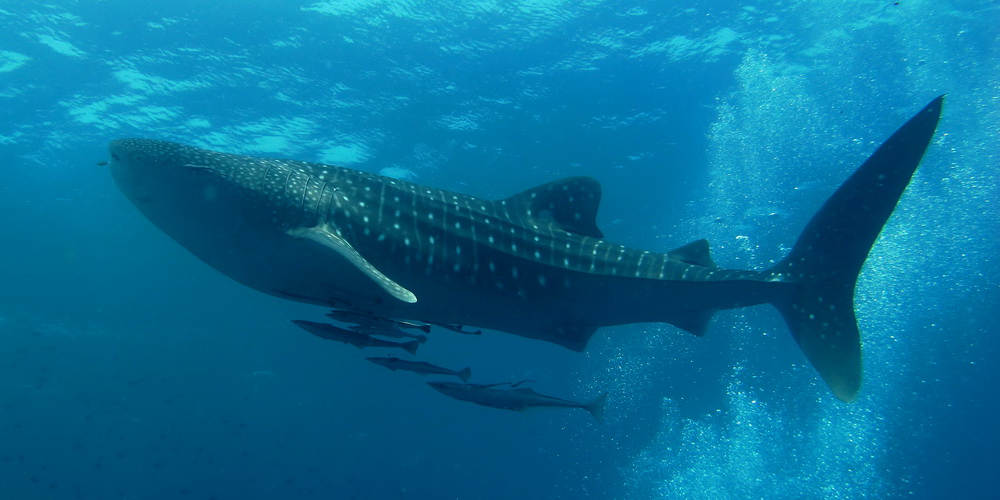
Walhai
Rhincodon typus
Tropische und subtropische Hochseewässer, von der Oberfläche bis 1.800 Meter Tiefe.
Massiver Körper mit weißen Flecken und Streifen auf grauem Untergrund. Das breite Maul kann 1,5 Meter Breite erreichen. Größter Fisch der Weltmeere.
Identification
The whale shark is impossible to confuse with any other fish. At up to 18 meters long and 20+ tonnes it is the largest living fish species. The skin is dark slate grey above, pale below, with a distinctive checkerboard of white spots and pale vertical and horizontal lines. Each individual's spot pattern is unique — researchers use the left flank behind the gills as a fingerprint, photographed and run through pattern-recognition software to catalog individuals across years and oceans.
The mouth is terminal (at the front of the head) rather than underneath, which sets sharks of the Rhincodontidae apart from most other cartilaginous fishes. Inside are around 300 rows of tiny vestigial teeth and a set of filter pads used to strain plankton from the water.
Distribution & Habitat
Whale sharks are circumglobal in tropical and warm-temperate waters between roughly 30° N and 35° S. They are highly migratory, following plankton blooms and spawning events. Known aggregation sites include Ningaloo Reef in Western Australia (March to July), Isla Mujeres in Mexico (June to September), Donsol in the Philippines (November to June), Djibouti (October to February), and the Maldives (year-round with seasonal variation).
Recent satellite tagging has revealed that whale sharks routinely dive to depths of 1,000 meters or more — vastly deeper than previously understood — likely feeding on deep scattering layer organisms during these excursions.
Behavior
Despite their size, whale sharks are slow-moving (around 5 km/h cruising) and entirely harmless to humans. They feed by ram filtration (swimming forward with an open mouth) or active suction feeding (hanging vertically and inhaling surface-concentrated prey). At productive aggregation sites you may see dozens of animals feeding side by side on coral spawn, fish eggs, or krill swarms.
Where to See Them
The best encounters are at known aggregation sites during peak season. Avoid operators who allow touching or riding — both are illegal in most jurisdictions and stress the animal. Good practice: stay at least 3 meters from the body and 4 meters from the tail, do not use flash, and never block the shark's swimming path.
Tropische und subtropische Gewässer weltweit. Wichtige Orte: Oslob (Philippinen), Holbox (Mexiko), Djibouti, Ningaloo Reef (Australien).
Filterfresser: Plankton, kleine Fischschwärme und Fischeier werden an der Oberfläche aufgenommen. Generell harmlos für Taucher.
Tauchtours finden, bei denen Sie diese Art treffen könnten:
Tauchtouren & Aktivitäten
Buchen Sie Taucherlebnisse bei lokalen Anbietern