 EN
EN
 ES
ES
 DE
DE
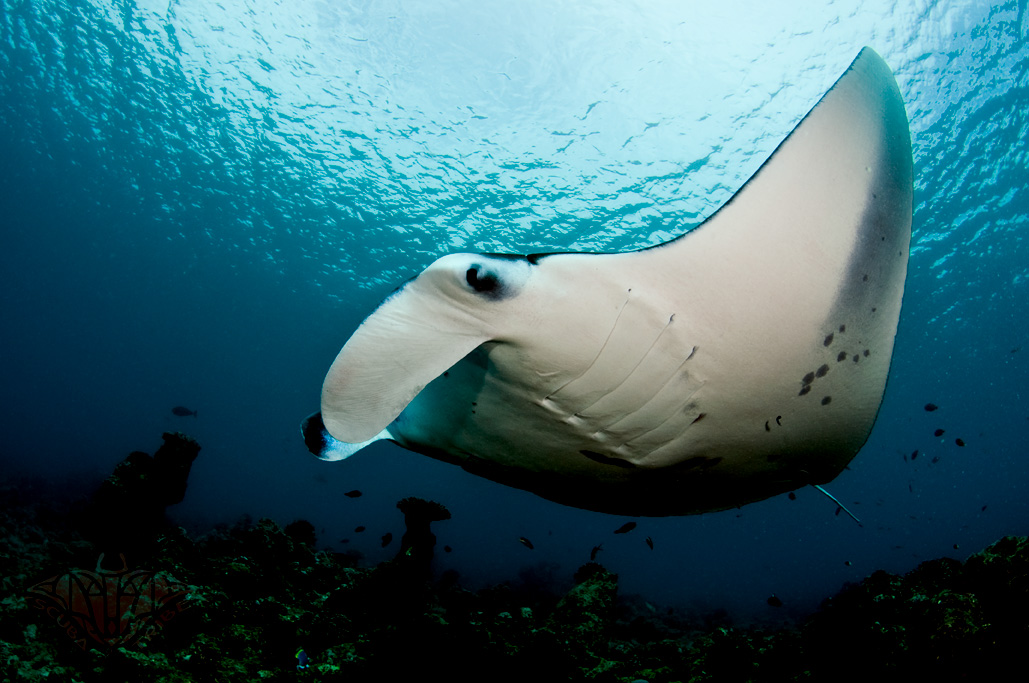
Riffmanta
Mobula alfredi
Tropische Küstenriffe, Lagunen und flache Auftriebszonen.
Ähnelt dem Riesenmanta, aber kleiner (bis 5 Meter Spannweite). Jedes Individuum hat ein einzigartiges Fleckenmuster auf der Bauchseite.
Identification
Reef mantas reach wingspans of up to 5 meters and are generally smaller than giant mantas. The easiest field mark is the mouth: reef mantas have a pale or white mouth area, while giant mantas have a black mouth. The shoulder patches form a Y-shape on the reef manta compared to a T-shape on the giant. Each individual has a unique ventral spot pattern, and researchers maintain ID databases of thousands of known animals worldwide.
Distribution & Habitat
Reef mantas are coastal and site-faithful, often spending years or decades at the same reef system. They are found throughout the tropical Indo-Pacific, with major populations in the Maldives, Indonesia (Komodo, Raja Ampat), Palau, Yap, Hawaii, Mozambique, and the Great Barrier Reef.
Behavior
These rays visit cleaning stations almost daily, where small fish pick parasites from their gills and bodies. At plankton-rich tidal channels they aggregate for group feeding — dozens of animals forming chains, barrel rolls, and feeding cyclones where they spin in a vertical column to concentrate prey.
Where to See Them
Hanifaru Bay in Baa Atoll (Maldives) hosts one of the largest feeding aggregations on earth between June and November. Manta Point in Komodo and German Channel in Palau are cleaning stations with year-round action. Maintain distance, stay low, do not chase, and never touch — the mucus layer on their skin is their first line of immune defense.
Tropischer und subtropischer Indo-Pazifik. Häufig auf den Malediven, in Indonesien, Mikronesien und im Roten Meer.
Standorttreuer als der Riesenmanta. Besucht jahrelang dieselben Putzerstationen und Fressgebiete.
Tauchtours finden, bei denen Sie diese Art treffen könnten:
Tauchtouren & Aktivitäten
Buchen Sie Taucherlebnisse bei lokalen Anbietern